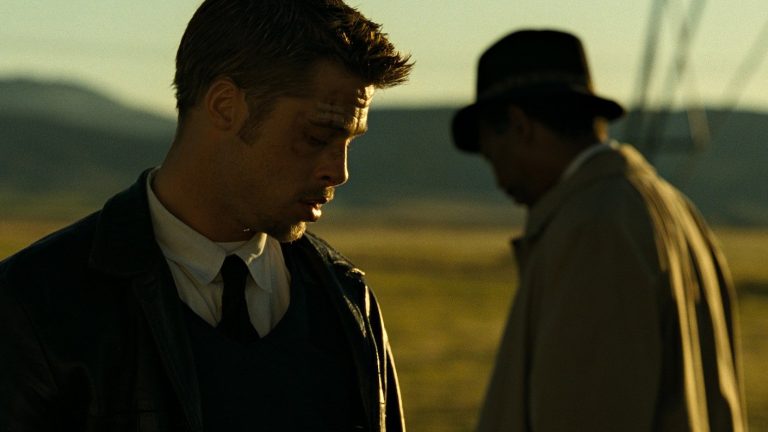
Se7en’s grimy, crushed-black look wasn’t a color grade bolted on in post, it was a chemical process cinematographer Darius Khondji fought to get approved, and it’s the reason the film still looks like nothing else from 1995. Khondji used a variation of bleach bypass, sometimes called CCE, to strip color out of the image and leave grain and contrast doing almost all of the emotional work.
What Bleach Bypass Actually Does to Film
Normal color film development bleaches away the silver in the negative once color dyes are formed, leaving a clean color image. Skip or reduce that bleach step and, as cinematographer Scott Dorsey put it describing the process, “you have a metallic silver black-and-white image superimposed on your color image.” That silver layer desaturates color, crushes blacks, boosts contrast, and thickens the grain structure, all at once, all from a single lab decision rather than anything done on set. Khondji told Netribution exactly what he was chasing on Se7en: “I wanted to use the silver process and push the stock to get a feeling of grittiness.” He also explained why the terminology shifted under him mid-career: “it’s not called silver retention anymore, it’s called bleach bypass or CCE in Los Angeles,” and that the effect “increases the sharpness and the contrast and it makes the actors almost larger than they are.”
Khondji Wasn’t Even the First
Se7en gets credited as the film that put bleach bypass on the map for a generation of cinematographers, but the technique is older than Khondji’s career. Per Wikipedia’s account, cinematographer Kazuo Miyagawa, a former chemist, invented the process for Kon Ichikawa’s 1960 film Her Brother, inspired by the black-and-white dye-transfer overlay Oswald Morris used on Moby Dick in 1956. Roger Deakins used it on 1984 in 1984 after studio financiers rejected his and the director’s request to shoot the film in black and white outright, reaching for bleach bypass as the closest legal substitute. Janusz Kamiński used it a few years after Se7en on Saving Private Ryan, for a completely different reason, wartime authenticity instead of urban dread. The technique is genre-agnostic. What Khondji did was prove it could carry an entire film’s tone from the first frame to the last.
The Look Changes With the Story, on Purpose
No Film School’s Jason Hellerman makes the point that Se7en’s grain isn’t static across the runtime, it tracks the plot. “It makes the movie look singular, and it evolves with this story from the cold rain to the hot desert as things intensify,” he writes. That’s a harder trick than picking one look and holding it: the bleach bypass process gives Khondji a consistent chemical baseline, but the exposure, the flashing, the stock choice underneath it all shift as the story moves from the perpetually rain-soaked city to the flat, sun-bleached highway where the film ends. Hellerman frames the overall aesthetic as functional, not decorative: “we feel the suffocation bearing down on the characters as the city breaks down all the deadly sins that can be bestowed upon its residents.” The grain isn’t texture for its own sake. It’s the thing standing between the audience and a clean, comfortable image, on purpose, for two hours.
Grain as Architecture, Not an Accident
What makes Se7en worth revisiting for anyone who grades or finishes footage today is how deliberately the grittiness was engineered rather than left to chance. Khondji didn’t get a gritty image because 1990s film stock was inherently gritty, he got it by choosing to skip a step in a chemical process that the entire industry had spent decades trying to perfect. That’s the same logic behind pushing grain and halation into a modern digital project instead of leaving it clean: the imperfection isn’t a limitation you tolerate, it’s a decision you make because a spotless image would tell the wrong story. Se7en is the reminder that the ugliest-looking choice on paper is sometimes the only one that makes the film feel true to what’s actually happening in it.
Sources:
- Netribution — Darius Khondji interview
- Wikipedia — “Bleach Bypass”
- No Film School — Jason Hellerman, “Tiny Details in ‘Se7en’ That Make It a Masterpiece”
- Cinematography.net — “Bleach Bypass” (Scott Dorsey)
Image: Se7en (1995), © New Line Cinema. Used for the purposes of criticism, review, and commentary under the fair dealing provisions of Section 29.1 of the Canadian Copyright Act (R.S.C., 1985, c. C-42). The image illustrates the editorial analysis above and is not used as a substitute for the original work or for independent commercial exploitation. All copyright in the image and the underlying film remains with its respective rights holders.