Children of Men’s car ambush sequence looks like one unbroken take: five minutes inside a moving vehicle as it’s attacked on a forest road, the camera swinging between actors with nowhere for a cut to hide. It isn’t actually unbroken. Alfonso Cuarón and cinematographer Emmanuel Lubezki built the illusion so well that it’s still cited as one of the great single-take sequences in film, sitting at No. 13 on BBC Culture’s 2016 poll of 177 critics ranking the 21st century’s greatest films — and the trick behind it is better craft trivia than the myth.
A Rig Built Because the Shot Didn’t Exist Yet
The problem was physical before it was creative: there was no way to put a camera operator inside a car with five actors and still get a shot that could swing freely around the cabin. Producer Eric Newman called the custom rig the crew built to solve it an “unbelievable piece of machinery,” and was blunt about why it had to exist: “You can’t fit a camera crew in a car.” Camera operator Frank Buono described the mechanism itself — “the Sparrow Head from Doggicam and two power slides, which work together to move the camera in and out, forward, backwards, right and left” — mounted above the roofless vehicle, giving the camera near-360-degree freedom without a single crew member visible in frame. Four people, including Cuarón, rode on a platform bolted outside the car; five actors performed inside it with no idea where the lens would point next, which is a large part of why the panic on screen reads as real.
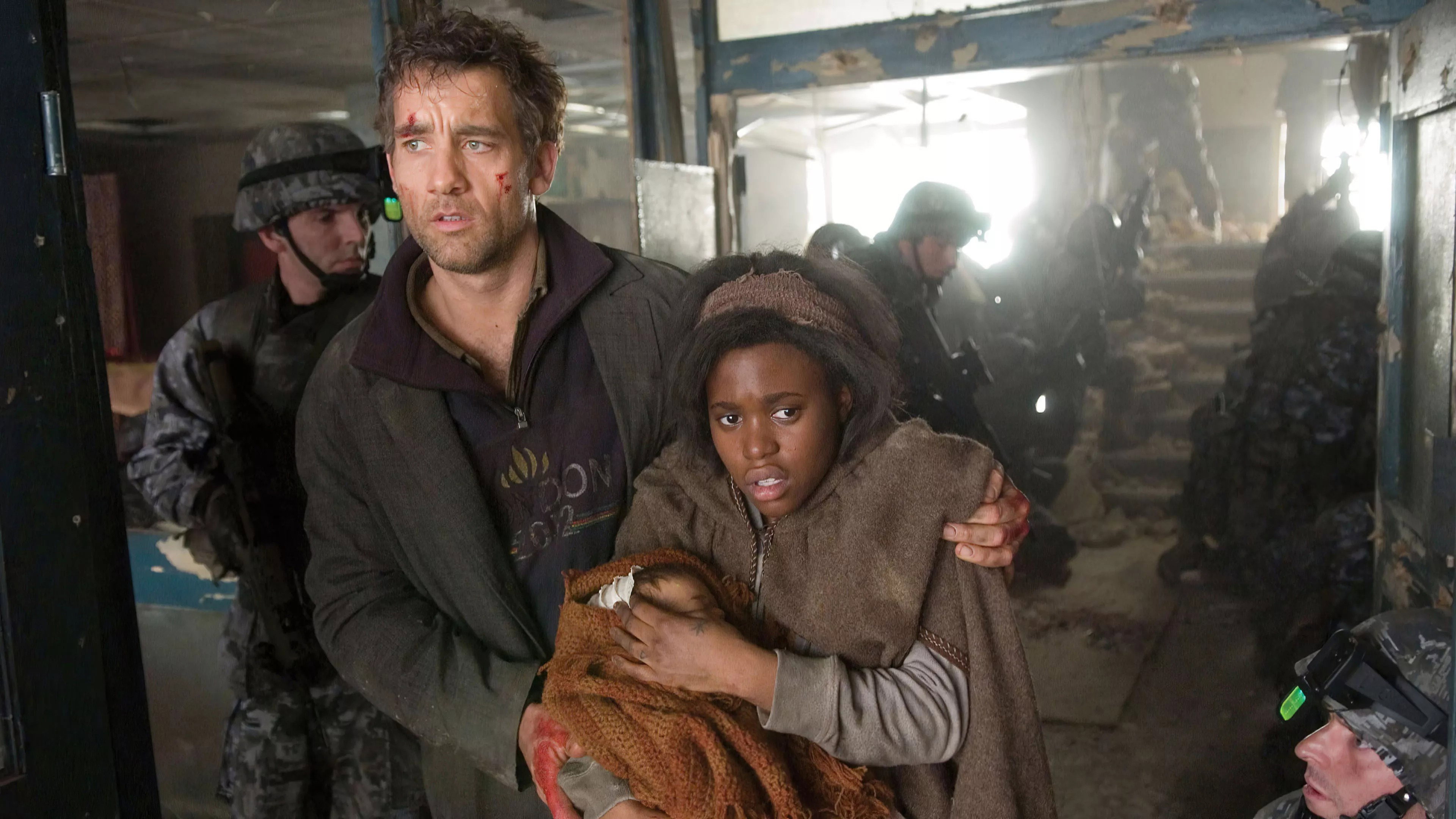
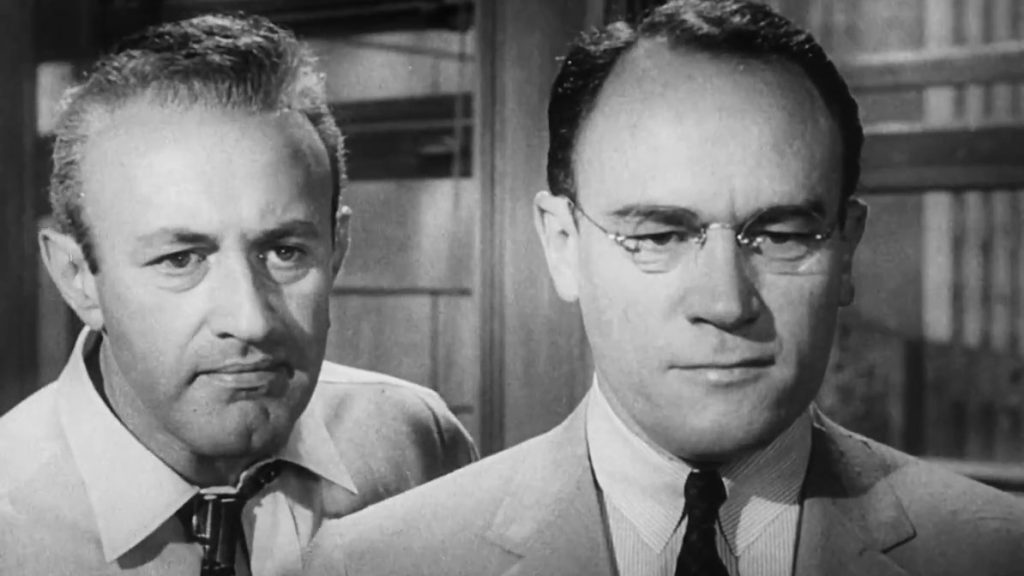
Image: Children of Men (2006), © Universal Pictures / Strike Entertainment. Used for the purposes of criticism, review, and commentary under the fair dealing provisions of Section 29.1 of the Canadian Copyright Act (R.S.C., 1985, c. C-42). The image illustrates the editorial analysis above and is not used as a substitute for the original work or for independent commercial exploitation. All copyright in the image and the underlying film remains with its respective rights holders.
What actually got the sequence on screen is less pure than the legend: it functions as several short scenes stitched together rather than one true unbroken take, with the cuts placed at moments — a bullet impact, the camera leaving the car to follow a character on foot — where the eye is least likely to catch the seam. That’s the part editors should sit with. The scene’s reputation rests entirely on making its edits invisible, not on eliminating them, which is a harder and more interesting job than shooting it for real in one pass.
The Blood on the Lens Was Never Supposed to Stay
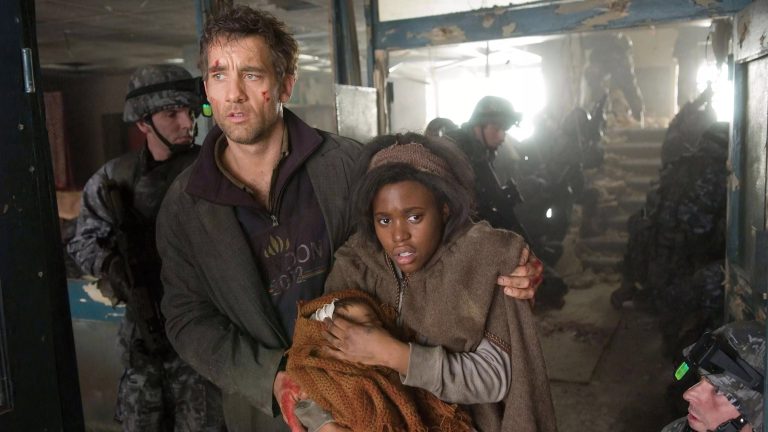
The film’s other famous long take, the refugee-camp finale, has an even better story behind it, because the most memorable image in it was a mistake. During the shot, blood from a nearby gunshot splattered directly onto the lens. Cuarón, watching on a small monitor, assumed the take was ruined: “When we arrived at the bus, the camera goes in, and blood splatters the lens. With my little monitor, I see that I cannot see anything. I yell, ‘Cut!'” Nobody heard him over a simultaneous explosion, so the camera kept rolling. Lubezki, reviewing the footage afterward, talked Cuarón into keeping it, calling the accident a “miracle” rather than a ruined shot. It stayed in the final cut and is now one of the most written-about single images in 2000s cinema — a blemish nobody planned that ended up doing more for the scene’s sense of chaos than a clean frame ever could have.
The pressure behind that finale was as real as the blood was accidental. The location was only available for fourteen days, and by day twelve almost nothing had been shot, eaten up by rehearsals and a limited number of practical-effects takes. A camera operator was injured in a fall during that stretch, leaving a single afternoon before losing the location entirely.
It’s Also Just a Film Stock, Not a Filter
One more detail worth knowing before you reach for a “Children of Men look” preset: there wasn’t one. Lubezki shot on Kodak Vision2 500T 35mm film in Super 35 through Arricam Lite and Arri 235 cameras, finished through a digital intermediate. The desaturated grey-and-cyan wash people associate with the film is a grading choice layered onto real film grain, not a LUT doing the work alone — worth remembering any time a “cinematic” preset promises to replicate a specific movie’s look in one click. And for anyone assuming a studio editorial team reshaped this film in the room next door: Cuarón co-edited it himself, alongside Alex Rodríguez, which tracks with how tightly the visual strategy and the cutting serve the same idea throughout.
Nearly two decades on, the sequences still get cited as technical benchmarks, but the more useful lesson for anyone editing today is the one that gets lost in the “one continuous take” framing: the goal was never the unbroken shot. It was making the audience believe in one, which took real cuts, a genuine accident, and a crew willing to leave both in.
Sources:
Wikipedia — “BBC’s 100 Greatest Films of the 21st Century” (citing BBC Culture, August 2016)
SlashFilm — Joshua Meyer, “Children Of Men’s Car Scenes Called For Inventing Brand-New Camera Tech”
Collider — Chris Sasaguay, “This Memorable ‘Children of Men’ Shot Was a Total Accident”
ShotOnWhat? — “Children of Men (2006) Technical Specifications”