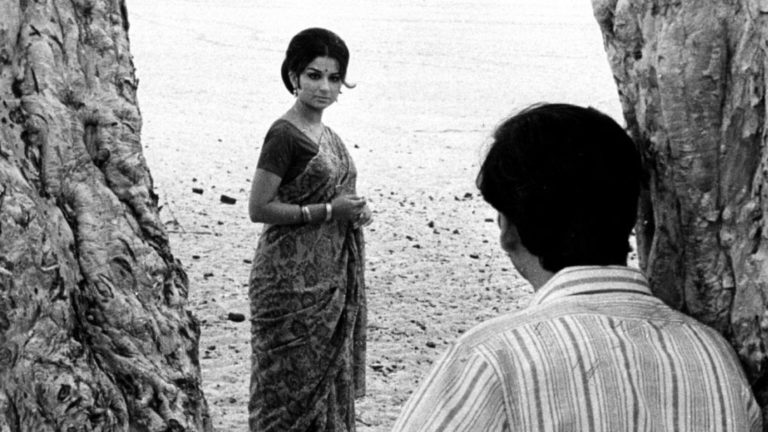
Satyajit Ray’s Days and Nights in the Forest hits Criterion on 4K UHD, Blu-ray, and DVD, with a street date of September 29. The 1970 film has spent decades as one of Ray’s least-seen major works outside India, circulating mostly on “shoddy prints and grainy online rips,” as A.V. Club critic Jacob Oller put it. That it exists in a clean restoration at all is because Wes Anderson personally pushed to save it.
Anderson, a devoted Ray fan, helped initiate the restoration years before the disc release, working with The Film Foundation’s World Cinema Project alongside the Film Heritage Foundation. The finished 4K restoration premiered at Cannes in 2025 before making its way to Criterion, and the new edition includes an introduction from Anderson himself plus a filmed discussion of the restoration process with star Sharmila Tagore and Film Heritage Foundation founder Shivendra Singh Dungarpur.
A Black-and-White Film That Knows Exactly What It’s Doing
The film follows four friends from Kolkata on a trip to the countryside, where their urban self-regard gets quietly dismantled by the people they meet there. Cinematographer Soumendu Roy, a longtime Ray collaborator, shoots it in high-contrast black-and-white that Oller describes as photography that “pops in the sun and vanishes into the night” — a visual language built specifically around the divide between the group’s overconfident daylight hours and their unraveling after dark. The opening credits alone do real work: the camera zooms from a moving vehicle into dense thickets until the image dissolves into what film critic Nathaniel Bell called “a hypnotic abstraction,” setting up a film about people who think they understand where they’ve arrived and clearly don’t.
Editor Dulal Dutta, who cut nearly every film Ray ever made, holds that tension together through small, exact choices rather than showy ones: cutting between faces lined up at a barroom table before dropping to blackout wreckage on a dark road afterward, or framing a bathing scene to make its vulnerability visible without a single line of dialogue announcing it.
The Scene Wes Anderson Couldn’t Leave Alone
The film’s most famous sequence is a memory game played on a picnic blanket: each player has to recite a growing list of “great men” from history, adding one new name each round, until someone forgets the sequence and is out. It plays as a party game for exactly as long as it takes to become something else — what Oller calls “a tense battle of wills and a layered struggle to seem sophisticated,” as the two central characters, Aparna and Ashim, narrow the contest down to just themselves, each one needling the other with increasingly specific names to prove they’re the sharper mind in the room. Aparna wins outright, then deliberately throws the final round to hand Ashim the victory, a small act that says more about the power balance between them than any line of dialogue in the film does.
Anderson liked the scene enough to restage it. Oller’s piece notes that Asteroid City directly homages the memory-game sequence, transplanting Ray’s structure of escalating one-upmanship dressed as a party game into Anderson’s own very different, very Andersonian register. It’s a rare, traceable line from one specific 55-year-old scene to a specific scene in a movie that played in theaters two years ago, and it’s the kind of craft lineage that’s easy to miss unless someone happens to restore the original and put it back in front of people.
Pauline Kael, writing in The New Yorker, once said Ray’s films “can give rise to a more complex feeling of happiness in me than the work of any other director.” Days and Nights in the Forest earned a Golden Bear nomination and a standing ovation at the New York Film Festival back in 1970 and then spent most of the next five decades hard to find in any watchable form. Its return isn’t just a restoration story. It’s a reminder that a film’s influence doesn’t stop just because the film itself became difficult to see.
Image: Days and Nights in the Forest (1970), © Priya Films. Used for the purposes of criticism, review, and commentary under the fair dealing provisions of Section 29.1 of the Canadian Copyright Act (R.S.C., 1985, c. C-42). The image illustrates the editorial analysis above and is not used as a substitute for the original work or for independent commercial exploitation. All copyright in the image and the underlying film remains with its respective rights holders.
Sources:
- A.V. Club — Jacob Oller, “Cult of Criterion: Satyajit Ray’s Days and Nights in the Forest”
- Film International — Nathaniel Bell, “Satyajit Ray’s Rich Humanist Comedy Restored: Days and Nights in the Forest (1970)”
- Wikipedia — Days and Nights in the Forest
- Films Fatale — “Criterion Crazy: September 2026 Releases”
- The Criterion Collection — Days and Nights in the Forest (1970)