Criterion put out a new 4K UHD restoration of “12 Angry Men” this month, and it’s worth using as an excuse to look at what the film is actually doing visually, because most people remember it as a writing showcase and forget it’s one of the most disciplined camera and editing jobs in American film. Twelve men, one room, ninety-six minutes, and Sidney Lumet turns that into a film that feels like it’s physically closing in on you by the end. That’s not the dialogue doing the work. That’s the lens and the cutting.
Ian White, covering the release for ecoustics, confirms the new disc arrived September 8 with a fresh 4K digital restoration in Dolby Vision HDR, the original 1.66:1 frame intact, and the uncompressed monaural track preserved rather than remixed into something it never was. Criterion also kept the 1954 Studio One live television version, Reginald Rose’s original teleplay for CBS, as a special feature, so you can watch the material before Lumet and cinematographer Boris Kaufman got their hands on it.
The Lens Plot Nobody Notices While It’s Happening
Kaufman, an Oscar winner for “On the Waterfront,” and Lumet built what Lumet himself called a lens plot: a deliberate, scene-by-scene progression from wide lenses to increasingly longer focal lengths as the deliberation drags on. V Renée, writing for No Film School, breaks down how the effect compounds with camera angle. Early scenes favor high angles and wide shots, which read as neutral and objective. As jurors start flipping their votes, the coverage shifts toward low angles and tight close-ups, the exact combination that reads as pressure and claustrophobia. Nobody in the audience clocks the mechanism. They just feel the room shrinking.
Eric D. Snider, in a piece for Mental Floss, adds the vertical half of the trick: Lumet shot the first third of the film from above eye level, the middle third at eye level, and the final third from below eye level, so that as the film goes on, the ceiling itself starts to creep into frame. The walls were never actually moving. The camera made you believe they were.
The Cut Is Doing the Same Job as the Lens
Editor Carl Lerner ran the same trick on pacing that Kaufman was running on focal length. Snider’s reporting notes the film opens on long, unbroken takes running past a minute with no cuts at all, then accelerates steadily as the argument in the room escalates. By Snider’s account, roughly half of the film’s entire cut count lands in the last twenty minutes. That’s not a coincidence and it’s not a byproduct of “more coverage existing” for the tense scenes. It’s a deliberate rhythm decision that mirrors exactly what the lens and the camera height are doing at the same time, three separate departments pulling the same rope.
It’s a genuinely useful thing to notice if you cut for a living, because it’s proof that “the edit should serve the emotional temperature of the scene” isn’t a workshop platitude, it’s a specific, measurable choice: twenty-second average shots at the start, four-second average shots by the end, built to match a room that never once changes location. You don’t need a second location, a bigger budget, or a single cutaway outside that jury room to make an audience feel trapped. You need a plan for how fast you’re going to cut, decided before you shoot a frame, and the discipline to actually follow it instead of cutting to whatever covers the dialogue.
Worth Revisiting, Not Just Rewatching
None of this is new information to film school syllabi, but it’s easy to lose track of when the film gets flattened into “the one with Henry Fonda and the jury.” The new restoration is a good excuse to actually watch for the lens plot and the accelerating cut pattern instead of just the performances, because it’s a rare case where you can point to the exact editorial and cinematographic mechanics of a film’s tension and verify they’re really there, shot by shot, rather than just feeling that something worked.
A black-and-white courtroom drama from 1957 outlasting seven decades of flashier camera work is its own argument for restraint. “12 Angry Men” never leaves the room. It never needed to.
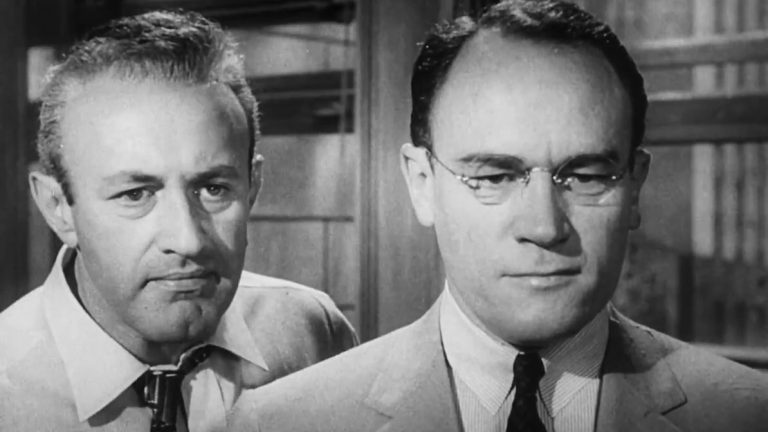
Image: “12 Angry Men” (1957), theatrical trailer frame. Public domain in the United States (published 1931–1977 without copyright notice).
Sources:
- ecoustics — Ian White, “Criterion Brings 12 Angry Men to 4K UHD and the Jury Room Has Never Looked This Uncomfortable”
- No Film School — V Renée, “How Camera Angles in ’12 Angry Men’ Indicate Character Highs and Lows”
- Mental Floss — Eric D. Snider, “10 Deliberate Facts About ’12 Angry Men'”
- Media Play News — “Catalog Titles Due on Disc in September 2026 From Criterion Include ’12 Angry Men,’ ‘Shoah'”
- Wikimedia Commons — “12 Angry Men” trailer frame, Lee J. Cobb and E.G. Marshall