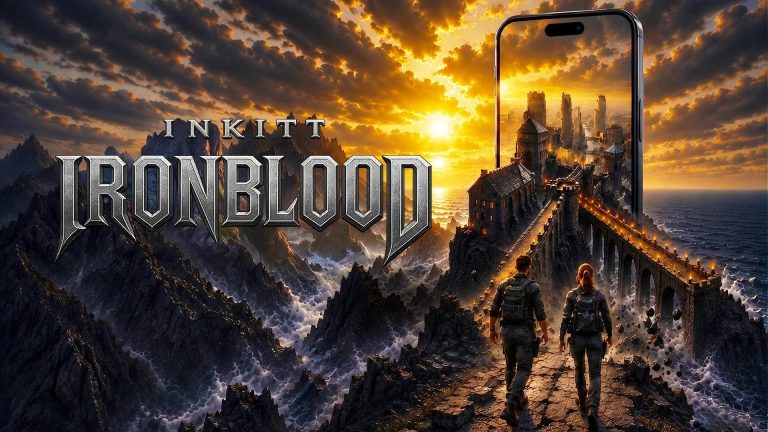
Photo: Inkitt, via Access Newswire
Inkitt just turned its internal filmmaking pipeline into a product anyone can rent. The company, better known as a self-publishing platform for aspiring novelists, has spent the last stretch of 2026 quietly converting its story catalog into AI-generated films for a brand called Ironblood. Now it’s opening up the tool that makes that possible: Inkitt Movie Creator, a public beta built on a proprietary orchestration system called Cinematica.
The distinction matters. Inkitt isn’t trying to out-model ByteDance’s Seedance or MiniMax with a new foundation video generator. Cinematica is a harness that sits on top of existing models and manages the parts that actually break down on a real production: character consistency, location continuity, prop tracking, and the tedious back-and-forth of getting a shot from “close” to “right.” As CEO Ali Albazaz told VentureBeat’s Carl Franzen, “We created this Formula One car, if you will, to help us create these movies internally, and now we’re turning it into a Honda CR-V so that externals can start using it.”
What Cinematica Actually Does
In the demo VentureBeat covered, a filmmaker first establishes the building blocks of a scene: who’s in it, where it’s set, what objects matter. Cinematica then generates several competing versions of that scene, the filmmaker picks the ones that work, and instead of re-prompting from scratch to fix a bad take, they talk to the system conversationally to adjust the shots that missed. That loop, generate, select, converse, revise, is the actual product. It’s less “type a prompt, get a clip” and more an assistant director who remembers what the last ten takes looked like.
Cinematica is deliberately model-agnostic. Per VentureBeat’s reporting, it currently routes work between ByteDance’s Seedance 2.5 for higher-quality, higher-cost shots and MiniMax H3 for cheaper iteration, choosing per shot based on quality and cost rather than committing to one vendor. That’s the more interesting engineering decision here: the harness survives even as the underlying models get swapped out, which is closer to how a real production pipeline should behave than most single-model AI video tools on the market.
The Price of Renting a Formula One Car
Movie Creator isn’t cheap and Inkitt isn’t pretending otherwise. VentureBeat reports credit bundles start at $10.61 for roughly 30 seconds of finished video and scale to $515.25 for about 25 minutes, which works out to somewhere around $20 to $21 per minute. Do the math on a 60-minute cut and you’re looking at close to $1,250 before any outside post-production touches it. There’s no API at launch, Inkitt says an integration with the system’s existing MCP server is planned, but for now this is a hosted tool, not a pipeline you bolt into your own editing stack.
That pricing puts Movie Creator in an odd middle zone: too expensive for casual experimentation, too manual for a studio pipeline that already has its own model routing built out. Where it actually lands is with the people Inkitt built it for in the first place, solo creators and small teams adapting existing scripts who don’t have a roughly 25-person production team feeding a harness every day, which is reportedly the scale of Inkitt’s own internal group behind Ironblood.
Why Editors Should Care About the Harness, Not the Hype
Every few weeks brings a new foundation model claiming better motion or sharper faces. Cinematica is a bet on the opposite problem: that the bottleneck in AI filmmaking isn’t model quality anymore, it’s continuity and control across dozens of shots in a single production. That’s an editor’s problem, not a researcher’s problem, and it’s telling that Inkitt built the fix by putting video producers in the loop rather than just throwing more compute at a bigger model. Inkitt itself acknowledges the harness hasn’t quantified how much production time it actually saves, so treat the efficiency pitch as a claim in progress, not a verified result, until someone runs an independent comparison.
Still, the shape of the product is a useful signal for where AI video tools are heading next: less about which model draws the sharpest frame, and more about who can manage continuity across a hundred of them without a human re-typing the same prompt a hundred times. Editors have known that discipline by another name for a century. It’s called continuity, and no model release has made it optional yet.
Sources:
Carl Franzen, VentureBeat, “Should Your Enterprise Build a Custom AI Harness? Inkitt Did for Its AI Video Creator, 5 Key Takeaways,” September 24, 2026
Inkitt, “Inkitt Movie Creator” product page, accessed September 2026