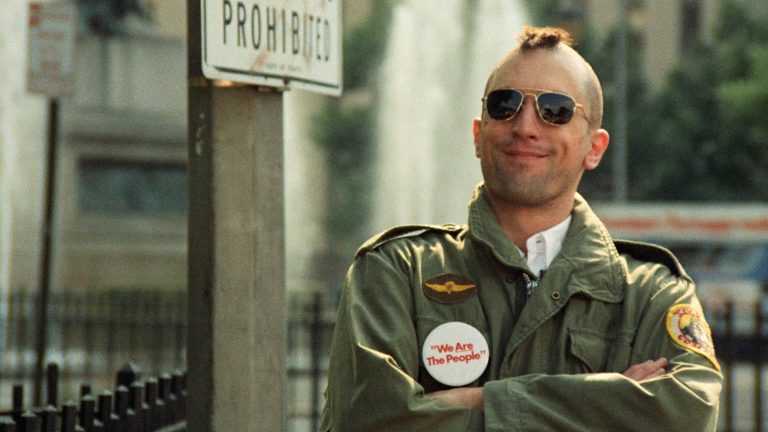
Taxi Driver came out in 1976. Chantal Akerman shot News from Home on the same New York streets that same year, releasing it in 1977. Sight and Sound’s September 2026 issue puts the two side by side in a piece by Becca Voelcker, calling them “striking time capsules of a past era” that read as newly relevant now. It’s a fair pairing, and not just because of the calendar. Both films are, in their own way, entirely about what a camera does to a decaying city — they just land on opposite answers.
Taxi Driver Built Its Color to Get Past the Censors, Then Lost the Alternative Forever
Cinematographer Michael Chapman shot Taxi Driver without the time or money for what he called “traditional things,” borrowing the loose, available-light instincts of Jean-Luc Godard and his DP Raoul Coutard — at one point, the crew crammed a sound recordist into the taxi’s trunk while Scorsese and Chapman worked from the floor of the back seat. The saturated, sickly reds and yellows people remember weren’t the original plan for the finale. To dodge an X rating from the MPAA over the shootout’s gore, Scorsese had the colors desaturated in the color-timing process, muting the brightness of the fake blood. He came to prefer it that way. Chapman didn’t, and said so on the film’s DVD commentary — but the point is moot now regardless of who was right, because the unmuted negative has since deteriorated. There is no other version left to compare it to. The choice made under rating pressure is, permanently, the film.
Chapman stayed protective of that texture decades later, when he supervised a restoration of the film. “I was trying to make it pristine, but I was trying to make it look what it looked like; I wasn’t going to change what it looked like,” he told The Film Stage. His complaint about most modern digital cinematography wasn’t really about sharpness or resolution — it was about sameness: “They’ve worked out a style with digital… but it all looks the same, whoever’s shooting it.” For a movie whose entire visual identity survives as a byproduct of a censorship fight and a decaying negative, that’s a pointed thing to say.
News from Home Just Let the City Sit There
Akerman’s approach was the inverse of Scorsese’s kinetic, hand-held, storyboarded chaos. News from Home is built almost entirely from long, static, exactingly composed shots of New York — Times Square’s subway platforms, Tenth Avenue, the Staten Island Ferry — held while Akerman reads letters her mother sent her between 1971 and 1973, added to the image afterward rather than recorded live. Cinematographer Babette Mangolte, who’d go on to shoot Jeanne Dielman and became one of Akerman’s closest early collaborators, photographed it without knowing the letters would even be part of the final film. The shots grow longer as the film goes on, until the city itself becomes the only thing left to look at. Made in seven days, on money left over from paying off Jeanne Dielman‘s debts, it now sits at 100% on Rotten Tomatoes across its (small) sample of reviews, and critic Jonathan Rosenbaum called it “one of the best depictions of the alienation of exile that I know.”
Same City, Same Year, Opposite Instincts
Put next to each other, the two films make a genuinely useful argument about what “capturing” a place even means. Chapman and Scorsese pushed in — hand-held, close, artificially juiced with color choices forced by a ratings board, cutting fast enough that the city becomes a hallucination filtered through one man’s paranoia. Akerman and Mangolte pulled all the way back and just waited, letting unbroken static shots of the same decade’s New York accumulate meaning through duration instead of movement. Neither one is more “real” than the other. They’re both just proof that a city on film is never neutral — someone is always deciding how long to hold the shot, and that decision is the whole film.
It’s the same instinct that keeps colorists and editors chasing scanned real 35mm grain instead of a synthetic imitation of it: the texture isn’t decoration on top of the image, it’s part of what the image is actually saying. Chapman’s negative degraded and took the “true” color of Taxi Driver with it. Nothing about that film reads as a loss of quality — it reads as the film. That’s worth remembering next time a restoration, or a grain pass, is treated as a purely technical decision instead of a creative one.
Image: Taxi Driver (1976), © Columbia Pictures. Used for the purposes of criticism, review, and commentary under the fair dealing provisions of Section 29.1 of the Canadian Copyright Act (R.S.C., 1985, c. C-42). The image illustrates the editorial analysis above and is not used as a substitute for the original work or for independent commercial exploitation. All copyright in the image and the underlying film remains with its respective rights holders.
Sources:
BFI Sight and Sound — “Sight and Sound: The September 2026 Issue”
Wikipedia — Taxi Driver
The Film Stage — “Michael Chapman Talks Restoring Taxi Driver and the Problem with Modern Cinematography”
Wikipedia — News from Home