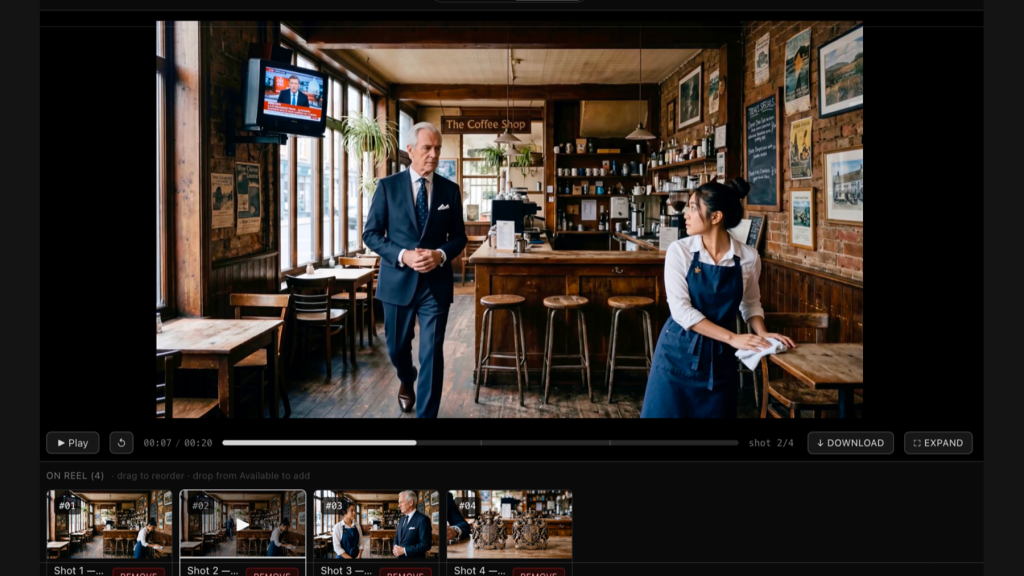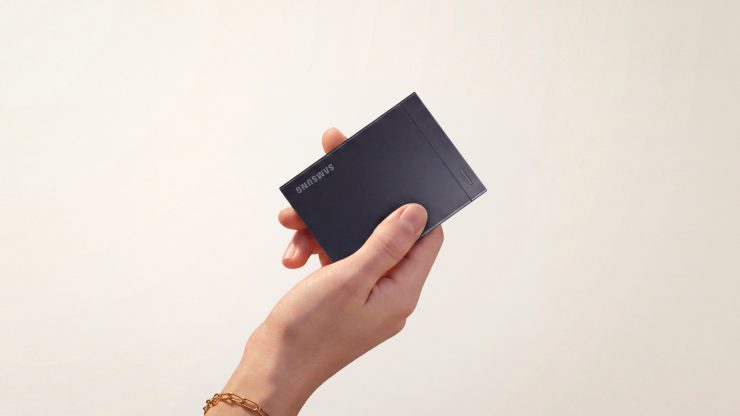
Samsung’s Portable SSD P9 is built for people who fill drives with 12K RAW: a USB4 unit rated to 4,000MB/s, up to 8TB, pitched squarely at professional production workflows. The launch film selling that pitch has an on-screen disclosure running through its entire runtime: “This content is created using generative AI.” Nothing in it is real. Not the cinematographer, not the location, not the camera, not a single frame of the footage supposedly filling the drive.
A Drive for Filmmakers, Sold Without Any
CineD’s Nino Leitner laid out the irony plainly in an opinion piece published this month: a drive marketed for holding footage nobody shot, using footage nobody shot. Samsung built a full reel and YouTube spot around a fictional cinematographer traveling the world, plugging the P9 into what looks like a RED PYXIS body, filling it with 12K that was never captured by anything. “Samsung did not use generative AI to tell a story it could not otherwise tell,” Leitner wrote. “It used it to skip the production budget.”
The tell was in the AI model’s own mistakes. Companion press photography for the P9 launch shipped with hallucinated pseudo-captions baked into the images — garbled fragments like “talephoto” and “vulture cirsting” — the kind of nonsense text generative image tools still can’t reliably avoid. Samsung’s Australian newsroom did label at least one image “Image simulated for illustrative purposes,” but that disclosure wasn’t prominent across the wider campaign, and the core generative-AI disclosure on the film itself only became widely noticed once creators started picking the footage apart.
“Would You Buy a Professional Drive From a Company That Skipped the Professionals?”
That question, posed on CineD’s Focus Check video series, is the one the campaign never answers well. The P9’s entire pitch depends on the buyer being a working cinematographer, colorist, or DIT who needs serious, reliable storage on set. The ad meant to reach that buyer was made without a cinematographer, a location scout, a gaffer, a grip, a sound recordist, or a colorist anywhere near it. Photographer and filmmaker Philip Bloom was among the creators who piled on once the story spread, and the backlash wasn’t really about AI tools existing — plenty of working editors already use generative AI for previz or storyboards without controversy. It was about a hardware company aiming a synthetic ad directly at the exact audience it was, in that moment, declining to hire.
The Problem Isn’t the Tool, It’s Who It Replaced
Leitner’s piece draws a useful line that’s easy to lose in the broader AI-video argument: generative tools used to visualize something a small team genuinely couldn’t otherwise afford to shoot are a different thing than a well-funded manufacturer using them to avoid paying for a shoot it could clearly afford. Samsung wasn’t a solo creator stretching a budget. It’s a company whose entire go-to-market for this specific product depends on the continued existence of people who shoot 12K RAW for a living — and it chose not to put a single one of them on camera, in front of the camera, or in the edit bay to sell it to the rest of them.
The P9 will probably sell fine on spec sheet alone; 4,000MB/s and 8TB in a pocketable USB4 drive is a genuinely good product regardless of how the ad was made. But the campaign is a clean case study in a distinction worth keeping straight as more manufacturers reach for the same shortcut: the question was never whether AI belongs anywhere near a film set. It’s whether the company asking you to trust it with your footage bothered to work with anyone who actually shoots any.
Sources:
CineD — Nino Leitner, “Opinion: The AI Ad Selling Storage to the Filmmakers It’s Replacing — Samsung’s Portable SSD P9 Campaign”
CineD — “Focus Check ep132: Samsung’s Filmmaker SSD Launch Film Is Entirely AI-Generated”
CineD — “Samsung P9 and P7 Portable SSDs Announced”
Samsung Newsroom — “Samsung Showcases P9 and P7 SSDs Featuring USB4 at Gamescom 2026”