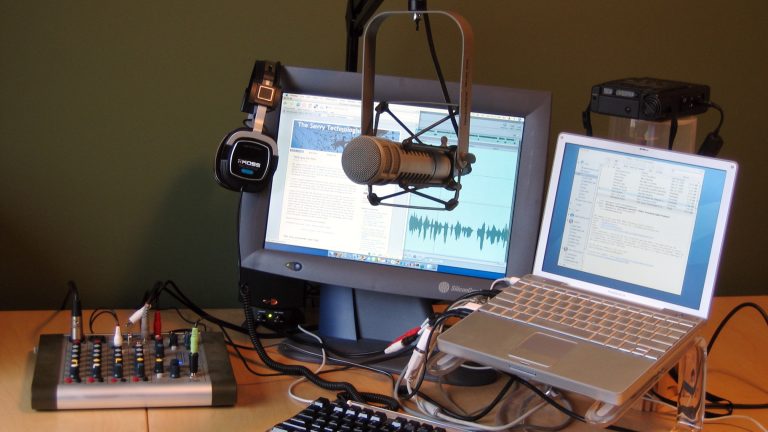
Photo: Tim Wilson, “The Podcave,” CC BY 2.0, via Wikimedia Commons
Mistral launched Voxtral 3 this week, a family of speech-to-text and text-to-speech models, and two parts of it matter to editors: a voiceover model priced at $13 per million characters and a set of transcription models that start at a fraction of a cent per minute. The rest of the launch is a voice agent SDK aimed at call centers, which you can ignore.
What Voxtral 3 Includes
Mistral’s announcement lists three transcription models and one voice model. Voxtral Small Transcribe 3 is pitched as the highest-accuracy multilingual option, Voxtral Mini Transcribe 3 is the efficient one, and Voxtral Mini Transcribe Realtime 3 is built for live use with sub-500ms latency. On the speech side, Voxtral Mini TTS 3 covers 35-plus languages and 50-plus dialects.
TestingCatalog reports a 4.1% forced error rate for Small Transcribe on the FLEURS benchmark and says Mistral claims it beats Whisper large-v3, among other transcription models. That is Mistral’s own benchmark comparison. Test it on your own interviews before trusting it with a client’s footage.
The Voiceover Model: Direction Without Brackets
The useful part for a video maker is how Voxtral Mini TTS 3 handles delivery. Mistral says the model reads emotion, pace and emphasis from the surrounding text on its own, and it also exposes explicit controls for emotion, pacing and emphasis. You can fix tricky pronunciations, such as a brand name or a place name, with phoneme hints.
That puts it in the same conversation as the directable voice models we covered recently, though the approach differs. Mistral wants you to write a normal script and let context set the tone, then override where it guesses wrong.
Voice cloning comes in two forms. According to Mistral, Pro Voice adapts to a speaker from about 30 minutes of audio and carries that voice’s character and emotional range across languages. The earlier March Voxtral TTS model, per Mistral’s docs, cloned from just a few seconds of audio, so check which model you are calling before assuming the shorter path still applies.
What It Costs and What You Can Do With It
Mistral’s pricing table, from the announcement:
- Voxtral Mini TTS 3: $13 per million characters
- Voxtral Mini Transcribe 3 (batch): $0.0035 per minute
- Voxtral Small Transcribe 3: $0.004 per minute
- Voxtral Mini Transcribe Realtime 3: $0.008 per minute
Proje Defteri works out that $13 per million characters comes to roughly 70 cents per hour of speech, and reports that you can try the models free in Mistral Studio without a credit card, under unpublished usage limits. Proje Defteri says it was written with AI, so treat its arithmetic and free-tier detail as secondary to Mistral’s own page.
For a working editor, the realistic uses are narrow but real. A scratch voiceover to time a cut before the talent records. Multilingual narration for a corporate explainer. A fast transcript to build subtitles from. At $0.0035 a minute, transcribing an hour of interview footage costs about 21 cents.
The Catches
Voxtral 3 is API-only. Proje Defteri reports there are no open weights and that on-premises deployment means talking to Mistral’s sales team. The older Voxtral 4B TTS model from March is available for non-commercial use only, under CC BY-NC 4.0, so it is not a loophole for client work. Preset voices cover 18 languages; the other languages need a cloned voice from a native speaker.
Clones also expire: the same report says cloned voices persist for 30 days by default and can be extended to 365 days. And as with every cloning tool, get written consent from whoever’s voice you are cloning, and check what your client contract says about synthetic narration.
Bottom Line
Voxtral 3 is not the most expressive voice model on the market, and Mistral has not shown it to be. What it offers is a low price and a clear way to steer a read, which is exactly what a temp track or a quick multilingual cut needs. Treat it like a scratch VO: great for finding the rhythm of an edit, and a decision to make later about whether the final pass still wants a human in the booth.
Sources: Mistral AI, “Voxtral 3” (Oct 20, 2026); TestingCatalog, “Mistral launches Voxtral 3 with a voice agent SDK” (Oct 21, 2026); Proje Defteri, “Voxtral 3 TTS: Free Tier, Pricing and Languages” (Oct 21, 2026); Mistral AI docs, Text to Speech.