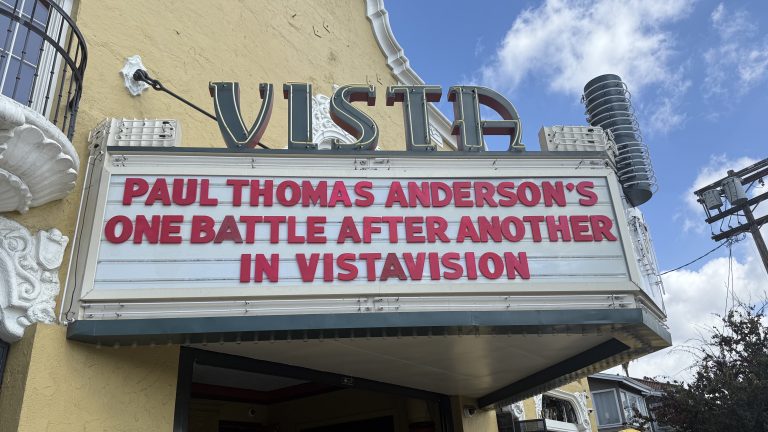
Sight & Sound’s annual critics’ poll for the best films of 2025 put Paul Thomas Anderson’s One Battle After Another at number one. The choice wasn’t a surprise to anyone who’d seen it, but the poll’s context is worth reading: Anderson topped the same poll in 2012 with The Master, and Mike Williams, Sight & Sound’s editor-in-chief, noted that the film “burrows deep into the fractures in society…while delivering the sheer exhilaration of pure, absolute cinema.” The BFI London Film Festival opens this week for its 70th edition, and the film is one of the reasons the 2025 poll still feels worth talking about now.
Photo: Sevgonlernassau, CC BY 4.0, via Wikimedia Commons
What made the film’s cinematography land the way it did comes down to one person and a 30-year journey to get there.
The 30-Year Apprenticeship
Michael Bauman spent three decades working with Paul Thomas Anderson before he became the sole director of photography on One Battle After Another. He started as a gaffer — the chief electrician on set, responsible for the lighting units and their placement, but always working under a DP’s creative direction. He did that on The Master and Inherent Vice. He stepped up to lighting cameraman on Phantom Thread, handling more of the technical decisions. On Licorice Pizza he was co-DP alongside Anderson himself. This film was the first time PTA gave him the title and the full responsibility outright.
The gaffer’s training shows in the work. Gaffer-level jobs are fundamentally about understanding how light actually behaves — not how it should behave in a controlled studio, but how it looks when it’s unruly, when sources mix, when the color temperature changes across a frame because the sun moved. That’s a different way of seeing a scene than someone who came up through camera operating or a film school cinematography program. When Bauman talked about the visual approach for One Battle, he described wanting “light that wasn’t sculpted.” PTA, he said, actively resisted attempts to normalize the look: “No, no, leave the messed up.” Color aberrations and inconsistencies were welcomed rather than fixed.
Three Kodak Stocks, One Film
The film was shot on three Kodak Vision3 stocks — 500T 5219, 250D 5207, and 200T 5213 — in VistaVision, the 8-perf horizontal 35mm format Paramount largely abandoned after the 1950s. Bauman’s choice of three stocks across varying light conditions rather than one stock rated differently reflects a commitment to letting each environment determine the texture, not a predetermined look imposed across everything.
The 500T is a fast tungsten-balanced stock that leans into grain in lower light. The 250D is a daylight-balanced stock with finer grain suited to outdoor work. The 200T is a slower tungsten stock with tighter grain for scenes with controlled artificial light. Running all three across a single film means the grain character changes as the locations change. That inconsistency is the point — Bauman said the film “has to have texture to it, it’s got to look like a movie,” and the texture he was after isn’t uniform. He also said the crew would “shoot ’til absolutely last light, to try and get anything in the sky we could” — that willingness to push into fading natural light is visible in the outdoor sequences, where the grain gets pronounced and the warmth from the lenses shifts against whatever color the sky was doing.
What VistaVision Brings
VistaVision runs film horizontally through the camera, using twice as much frame area as standard 35mm anamorphic. More area means finer grain relative to the image size — but Bauman and Anderson weren’t after a clean look. They were after a big canvas: “this movie is such a big canvas,” Bauman told Kodak’s blog, describing why the format fit the film’s sprawling, action-driven geography. The wider gate also means the image samples more information, which gives the negative more latitude in the grade. That’s useful when you’re shooting to last light and accepting whatever the exposure gives you rather than building toward a safe, controllable target.
They got their hands on a vintage VistaVision camera originally owned by actor-turned-cinematographer Giovanni Ribisi. Two additional bodies came from Geo Film Group. There are very few working VistaVision cameras left, which makes the format choice partly an act of material constraint — you shoot with what you can find, and you make the constraint work for the story.
What Critics Responded To
Bauman received an Academy Award nomination for Best Cinematography for the work. The Sight & Sound poll put the film at number one over a year that included Ryan Coogler’s Sinners at two, Kelly Reichardt’s The Mastermind at three, and Oliver Laxe’s Sirāt at four. That’s a strong year for visual filmmaking with a clear preference for work that uses the specific material properties of its format rather than approximating a look in a grade.
What the critics responded to in One Battle After Another was a film that looked intentionally messy — not in a way that reads as technically incompetent, but in a way that reads as earned. That’s what 30 years of watching light actually behave produces, when you finally get to put it on a big canvas and leave the messed up in. The difference between real film grain from an actual scan and a digitally generated grain texture is exactly what separates the look Bauman got from a post-production approximation of it.
Sources:
Kodak — One Battle After Another (official Kodak Motion Picture blog)
Deadline — ‘One Battle After Another’ Tops Sight And Sound’s 2025 Best Films Of The Year List
Sight & Sound / BFI — 50 Best Films of 2025 (Letterboxd)
in70mm.com — About “One Battle After Another” in VistaVision by Paul Thomas Anderson
Wikipedia — One Battle After Another
BFI — London Film Festival 2026 (festival dates in source)