Criterion is releasing “Three Films by Leos Carax” on September 29 — new 4K restorations of “Boy Meets Girl,” “Mauvais Sang,” and “The Lovers on the Bridge” — and for the first time, the set includes a bonus feature built entirely around the man who shot all three: cinematographer Jean-Yves Escoffier. It’s overdue recognition for someone whose work defined those films as much as Carax’s direction did, and whose name most people who love them still can’t place.
The Man Who Turned Paris Into a Dreamscape
Escoffier, a graduate of Paris’ École Louis Lumière, shot all three of Carax’s early features before going on to work with Gus Van Sant on “Good Will Hunting” and Harmony Korine on “Gummo.” He won the European Film Award for Best Cinematographer for “The Lovers on the Bridge” and was nominated for a César for “Mauvais Sang.” He died of a heart attack in 2003, and “The Human Stain,” his final film, was dedicated to his memory. Critic David Sterritt, writing in Cineaste, describes him as “an indispensable link in Carax’s partnerships” alongside actor Denis Lavant — a way of saying the visual language and the performance were never separable in these films. Critics Cristina Álvarez López and Adrian Martin put it more vividly in their video essay on “The Lovers on the Bridge,” writing that Escoffier’s camera “takes us by force into a realm in which we shuttle back and forth, in the space of a cut, between the gutter and the stars, between reality and dream.”
The Bridge That Wasn’t Actually There
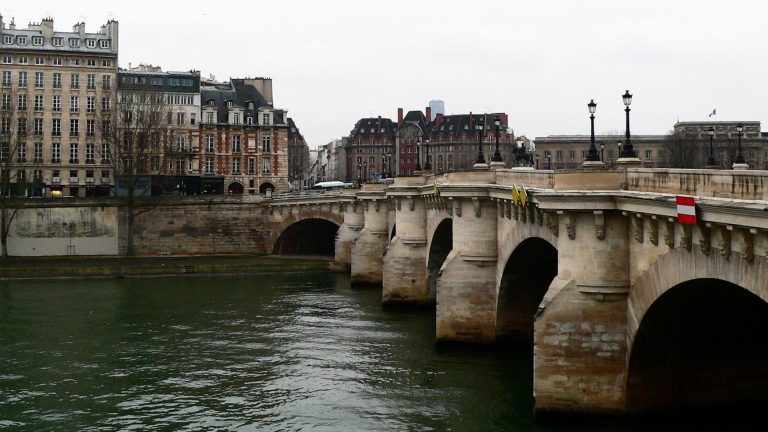
The making of “The Lovers on the Bridge” is the best trivia in the set, and it’s true. Carax needed extended access to the real Pont Neuf in central Paris; city permits gave the crew three or four weeks in August 1988 before renovation work shut them out entirely. Rather than abandon the film, the production built a full-scale replica of the bridge, complete with Henri IV’s equestrian statue, a working facade of the La Samaritaine department store, a Métro station entrance, and the actual trees of Vert-Galant park, on a field in Lansargues in the south of France. Le Figaro called it the biggest film set ever built in France. Financing it took three separate shoots spread across three years — the original 1988 dates, a second round funded by a Swiss financier in 1989, and a third bankrolled in 1990–91 by producer Christian Fechner, who bought out the accumulated debts to finish the film — with a final budget estimated between 100 and 200 million francs. A local farmer demolished the entire replica in January 1991, once the production had no further use for it.
That’s the part worth sitting with as an editor or DP rather than just as trivia: Escoffier lit and shot a “Paris” that was fake down to the trees and the Métro tiles, including a full recreation of a Bastille Day fireworks display, and the result is still cited as one of the most romantic, most convincingly Parisian images of the city ever put on film. The illusion cost a fortune and multiple years, but it was built entirely out of light, blocking, and camera placement doing the work that location authenticity usually does for free.
What’s Actually in the Box
Beyond the new restorations — uncompressed monaural on the first two films, 5.1 DTS-HD Master Audio with Dolby Vision HDR on “The Lovers on the Bridge” — the set pairs new interviews with Lavant and with editor Nelly Quettier alongside the Escoffier essay, plus Carax’s 2024 self-portrait film “It’s Not Me,” the 2014 documentary “Mr. X: A Vision of Leos Carax,” a making-of documentary shot during the 1991 production, deleted scenes, rushes, screen tests, and a new essay by author Amina Cain. Putting an editor’s interview and a dedicated cinematography essay in the same box is a small curatorial choice that treats the cut and the image as one continuous decision rather than two separate crafts — which is exactly how these three films were actually made.
Grain, practical light, and a replica bridge in a field outside Montpellier all did the same job on this film: convince an audience that a Paris which no longer physically existed as filmed was the real one. That’s still the entire trick, whatever the toolset, and it’s worth remembering the next time a “cinematic” preset promises to manufacture the feeling in one click.
Sources:
Cultsploitation — “Three Films by Leos Carax (4K UHD/Blu-ray)”
Wikipedia — “Jean-Yves Escoffier”
Wikipedia — “Les Amants du Pont-Neuf” (citing Le Figaro)
MUBI Notebook — Cristina Álvarez López and Adrian Martin, “Video Essay: Water and Stone, ‘The Lovers on the Bridge'”
Cineaste — David Sterritt, “The Lovers on the Bridge”