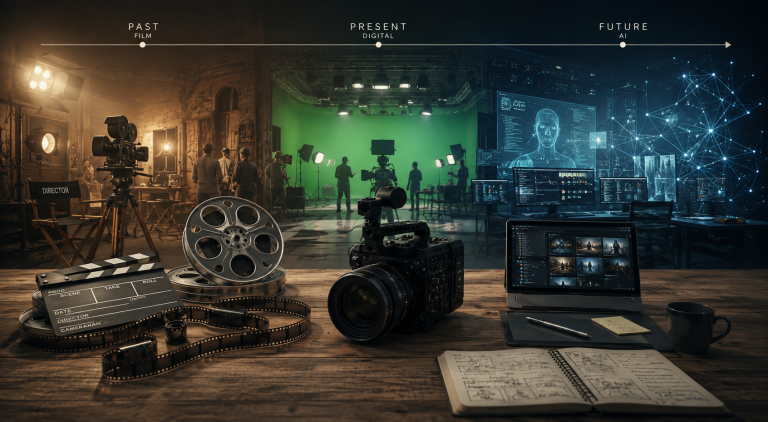
Every generation of filmmakers picks a hill to die on. A few years ago it was celluloid versus digital. Now it’s AI. History suggests the people who end up shaping a new tool aren’t usually the loudest voices arguing about it. They’re the quieter ones already putting it to work.
Round One: Film vs. Digital
David Lynch converted completely. Promoting Inland Empire in 2006 — his first film shot entirely on digital — he didn’t hedge: “Film is like a dinosaur in a tar pit,” he said, calling celluloid impractical, dirty, prone to scratching, and declaring himself done with it for good.
Quentin Tarantino took the opposite extreme. At Cannes, he called the shift to digital projection “the death of cinema as I know it” — “just television in public” — and predicted the next generation would eventually demand “the real thing” back, the way vinyl clawed its way back after decades of digital audio.
The most interesting case is Emmanuel “Chivo” Lubezki. He didn’t switch out of ideology but necessity. While preparing The Revenant, tests showed film couldn’t handle the extreme low-light conditions of shooting only at dawn and dusk. Digital solved the problem so convincingly that he ended up calling film grain “the downside of film” and described the switch as “my divorce from film — finally.”
Three filmmakers, one new tool, three verdicts: liberation, death, and a technical problem finally solved.
Round Two: Same Fight, New Technology
Swap “digital” for “generative AI” and the cast reshuffles into nearly identical roles.
Guillermo del Toro is this era’s Tarantino, if anything louder — asked his stance on AI, his entire reply was four words: “I would rather die.” Accepting a tribute for Frankenstein, he thanked his crew for a film “willfully made by humans, for humans,” then closed with: “Fuck AI.” Worth noting, though: his stated objection isn’t really about the technology itself. He’s said his actual concern is “natural stupidity” — the same hubris he built into his Frankenstein character. That’s a considered position about who’s driving the tool, not a reflexive fear of the tool itself.
James Cameron may be the closest thing this debate has to a Lubezki — pragmatic, sitting on the board of Stability AI, openly saying generative AI could cut VFX costs in half, while still confirming zero AI touched Avatar: Fire and Ash and calling the current moment “the Wild West.” The difference is that Lubezki had already made his call on a real production; Cameron is still circling his. His sharpest line cuts at the technology’s actual ceiling: because AI models are trained on everything already made, what they produce is “essentially all of human art and human experience put into a blender” — an average, not something new.
Steven Spielberg occupies a fourth position that didn’t really exist in the film-vs-digital fight: not opposed to AI, but drawing a precise line around authorship. His clearest image for it — a writers’ room with six people and an empty chair, a laptop in front of it, standing in as a seventh writer. “I’m not willing to substitute,” he said. His actual rule: “Use AI as a tool, but do not use AI as the final word on anything creative. That’s where I draw the line.”
The Working Artist’s Position
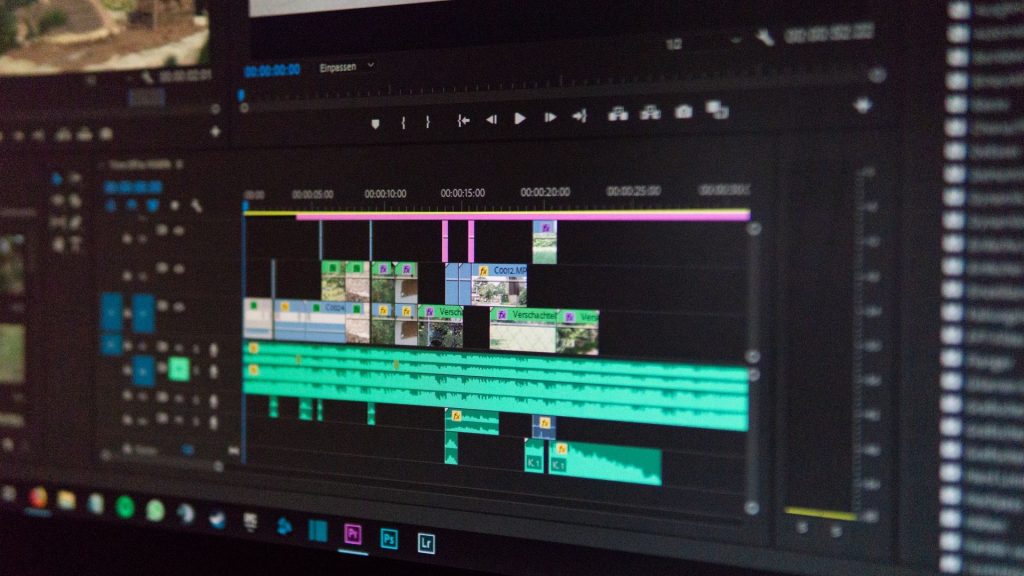
Here’s what’s genuinely new this time, and it’s the part worth sitting with. A growing number of working artists — the people whose jobs are theoretically most exposed — aren’t picking an extreme at all. They’re redesigning their workflow around AI on purpose, the same way an earlier generation redesigned around non-linear editing once it stopped being a novelty and started being a tool that removed drudgery.
Industrial Light & Magic, the studio that helped invent modern VFX, recently released Star Wars: Field Guide, its first publicly credited generative-AI short, made by artist Landis Fields and championed by ILM’s Chief Creative Officer, Rob Bredow. On the far less glamorous end of the same pipeline, Foundry’s CopyCat tool reportedly handled roughly forty percent of the thousand-plus Fremen eye-replacement shots on Dune: Part Two with no additional touch-up needed, saving the compositing team thousands of hours of rotoscoping. One is a credited creative work, the other is invisible technical labor — but both are the same instinct: use the tool where it removes the boring part, keep total control over everything that actually requires an eye.
That’s the honest middle ground most of the loudest headlines skip over: not every artist rejecting AI is doing it out of fear, and not every artist using it has surrendered their judgment to it. Del Toro’s objection is philosophical, not panicked. ILM’s approach isn’t capitulation — it’s the same instinct editors had in the ’90s when non-linear software let them stop physically splicing tape.
The Question Nobody’s Answering Yet
There’s one more parallel worth raising honestly, because it cuts both ways. In 2010, a lot of people insisted digital “looked fake” — flat, sterile, missing the thing film had. Today, most audiences can’t tell an Alexa shot from a 35mm frame without being told. A decade of technical refinement closed a gap that once seemed obvious and permanent.
The same claim gets made about AI video constantly right now — it “looks fake,” something’s always slightly off. The honest question is whether that’s a permanent, structural ceiling on the technology, or just what every new format sounds like in its first five years, before anyone’s had time to solve the problems that are obvious today. Nobody actually knows the answer yet.
What History Actually Teaches Here
The film-vs-digital war didn’t end with a winner. It ended with filmmakers using whichever tool served the story they were telling — Lynch going handheld digital to get inside a character unraveling, Lubezki switching formats mid-career because the shot demanded it. Most audiences never cared which format made the movie. They cared whether it moved them.
AI probably won’t replace filmmakers the way many fear. It may simply replace parts of the workflow, exposing who was relying on the tool instead of the craft all along.